

WTO: 2012 NEWS ITEMS
WTO AND OTHER ORGANIZATIONS
MORE:
> Joint Summary on G-20 Trade and Investment Measures (OECD/WTO/UNCTAD)
> WTO Report on G-20 Trade Measures
> Annex 1: G-20 trade and trade-related measures (mid-May 2012 to mid-October 2012) (Excel Format)
> Summary and Status of G-20 trade and trade-related measures since October 2008 (Excel Format)
> OECD/UNCTAD Report on G-20 Investment Measures
Summary of WTO Report on
G-20 Trade Measures
(Mid-May 2012 to mid-October 2012)
The world has so far avoided a serious protectionist breakout, but the situation bears watching
There has been a slowdown in the imposition of new trade restrictive measures by G-20 economies over the past five months. Nevertheless, the new measures are adding to the stock of restrictions put in place since the outbreak of the global crisis, most of which remain in effect. G-20 governments need to redouble their efforts to keep their markets open, and to advance trade opening as a way to counter slowing global economic growth. As noted in previous monitoring reports, trade restrictions and inward-looking policies will only aggravate global problems and risk generating tit-for-tat reactions. The difficulties and concerns generated by the persistence of the global economic crisis, with its many facets, fuel the political and economic pressures put on governments to raise trade barriers. This is not the time to succumb to these pressures.
Moreover, at a time of continuous economic difficulties, trade frictions seem to be increasing. They are reflected not only through trade remedy and dispute settlement cases under the WTO, but also through decisions affecting foreign investment and participation in infrastructure-related government procurement programmes.
Prospects for the global economy are highly uncertain
Over the past few months, the global economy has encountered increasingly strong headwinds. The outlook for the global economy is worse than at the time of release of the previous G-20 monitoring report due, among other things, to budget developments and the persistent debt crises in some major economies. Output and employment data in many countries have continued to disappoint, despite the many measures implemented to contain the slowdown in economic growth. In the face of these developments, the WTO Secretariat has recently revised downward its forecast for world trade growth in 2012 to 2.5% from its 3.7% forecast issued in April 2012. The volume of trade growth in 2013 is now forecast to be at 4.5%, still below the long-term annual average of 5.4% for the last 20 years.
The trade slowdown in the first half of 2012 was driven by a marked deceleration in imports of developed countries and by a corresponding weakness in the exports of developing economies. For the whole of 2012, merchandise exports from developed countries are expected to grow by 1.5% and those from developing countries by 3.5%.
Chart 1: Growth in volume of world merchandise trade 2008-2013
(annual percentage change)
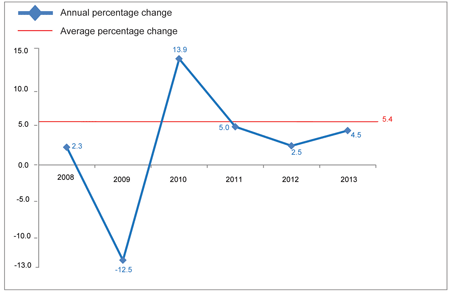
Note: Volume of merchandise trade is the average of exports and imports. Figures for 2012 and 2013 are projections.
Source: WTO Secretariat.
There has been a slowdown in the implementation of new trade restrictions
Since mid-May 2012, 71 new trade restrictive measures have been recorded, covering around 0.4% of G-20 merchandise imports, or 0.3% of world imports (see Table 1). The most frequent measures used continue to be trade remedy actions, in particular the initiation of anti-dumping investigations, followed by more stringent customs procedures. There were fewer new export restrictions introduced over the past five months than in previous periods (see Table 2).

> Problems viewing this page?
Please contact [email protected] giving details of the operating system and web browser you are using.
Table 1: Share of trade covered by import restrictive measures
(Per cent)
Share in world/ G-20 imports |
October 2008 to October 2009 |
November 2009 to May 2010 |
Mid-May 2010 to mid-October 2010 |
Mid-October 2010 to April 2011 |
May 2011 to mid-October 2011 |
Mid-October 2011 to mid-May 2012 |
Mid-May 2012 to mid-October 2012 |
Cumulative total |
Share in total world imports |
0.8 |
0.4 |
0.2 |
0.5 |
0.5 |
0.9 |
0.3 |
3.5 |
Share in G-20 imports |
1.0 |
0.5 |
0.3 |
0.6 |
0.6 |
1.1 |
0.4 |
4.4 |
Some of the reported trade restrictions have been implemented on a temporary basis. However, past experience shows that, once in place, these measures tend to remain permanent as they build domestic political constituencies.
Table 2: Trade-restrictive measures
Type of measure |
April 2009 to August 2009 |
September 2009 to February 2010 |
March 2010 to mid-May 2010 |
Mid-May 2010 to mid-October 2010 |
Mid-October 2010 to April 2011 |
May 2011 |
Mid-October 2011 to mid-May 2012 |
Mid-May 2012 to mid-October 2012 |
(5 months) |
(6 months) |
(3 months) |
(5 months) |
(6 months) |
(6 months) |
(7 months) |
(5 months) |
|
Trade remedy |
50 |
52 |
24 |
33 |
53 |
44 |
66 |
46 |
Border |
21 |
29 |
22 |
14 |
52 |
36 |
39 |
20 |
Export |
9 |
7 |
5 |
4 |
11 |
19 |
11 |
4 |
Other |
0 |
7 |
5 |
3 |
6 |
9 |
8 |
1 |
Total |
80 |
95 |
56 |
54 |
122 |
108 |
124 |
71 |
More trade facilitating measures were recorded
This time, measures facilitating trade outnumber those that can be considered as trade restricting. Around 55% of the total number of new measures recorded over the past five months are trade facilitating, compared with 45% at the time of the previous monitoring report. The trade facilitating measures cover around 0.7% of G-20 merchandise imports.
But accumulation of trade restrictions remains a concern
The new measures implemented over the past five months which can be considered as restricting or potentially restricting trade add to the restrictions adopted since the outbreak of the global crisis. The trade coverage of the restrictive measures put in place since October 2008, excluding those that have been terminated, is estimated to be around 3% of world merchandise trade, and around 4% of trade of G-20 economies.
The pace of removal of previous restrictions is slightly better than at the time of the previous report. Out of the total measures that can be considered as restricting or potentially restricting trade implemented since October 2008, 21% have so far been eliminated. At the time of the last monitoring report in May 2012, around 18% of the restrictive measures had been removed.
One of the dangers in the accumulation of trade restrictive measures is that the benefits of trade openness will be slowly and incrementally undermined. Moreover, the accumulation of measures has to be considered in a broader perspective where the stock of trade restrictions and distortions that existed before the global crisis struck, such as trade-distorting subsidies in agriculture and tariff peaks, are still in place.
G-20 governments should show leadership in preserving market openness
Multilateralism is struggling on many fronts, and active support for collective action is faltering. The world urgently needs a stronger and renewed commitment, in particular from the G-20 economies, to revitalize the multilateral trading system which can restore economic certainty at a time when it is badly needed. The policy determination to resist protectionism in all its forms seems to be faltering in some countries, even as the world economy needs more trade to stave off recession. Due to the changing patterns of world trade, restrictions on imports will inevitably be felt in reduced export competitiveness, with production chains becoming more and more global. The last thing the world economy needs right now is indulgence in trade restrictive practices.
Even if it is clear that the goal of achieving a Doha package encompassing 20 topics among the WTO's 157 Members is out of reach in the short-term, the possibility still exists of advancing in smaller steps. This possibility should not be lost.
Note
This is intended to be a purely factual report and is issued under the sole responsibility of the Director-General of the WTO. The report has no legal effect on the rights and obligations of WTO members, nor does it have any legal implication with respect to the conformity of any measure noted in the report with any WTO Agreement or any provision thereof. This report is without prejudice to members' negotiating positions in the Doha Round.
The full report is available on the WTO website at www.wto.org.