WTO
GENERAL COUNCIL
31 July 2002
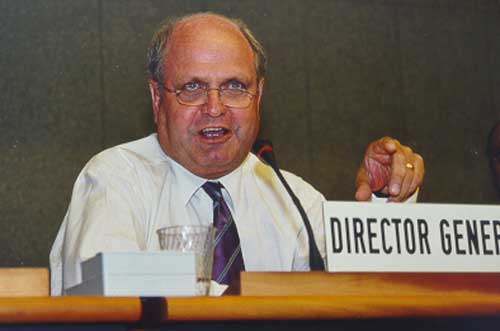
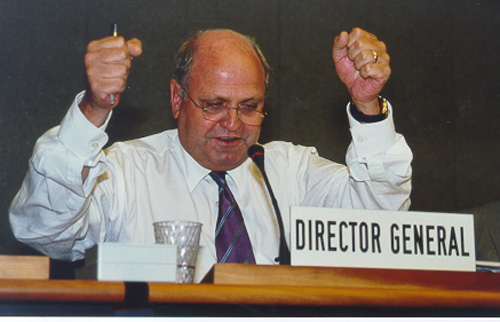
Director-General's farewell speech to the General Council
SEE
ALSO:
press
releases
WTO news
archives
Mike
Moore's speeches
> TNC Chairman's report to General Council
In my farewell speech to the New Zealand Parliament, in 1999, I described my new position at the WTO as continuing a life-long career in public service. I said I would travel to Geneva and give this job everything I have got. I have done that.
I travelled here with an agenda. Yes, I was biased. I wanted to see a new round launched with development issues at the centre. I wanted to enlarge our membership. I wanted to re-position the WTO and advance multilateralism.
As my term as Director-General of the World Trade Organization nears its conclusion, as I clear my desk and take down the paintings of beautiful New Zealand landscapes from my office wall, I want to tell you that every day that I have been able to serve this institution has been a great personal honour and every day has been a privilege.
It is not my intention here to rehearse the history of our time together. That will be the subject of my next book which, when completed, will be available in all good bookstores. I come out of it pretty well but I have instructed the publisher not to put your names in the index so you will have to buy the book.
Three years on, I believe we are entitled to look back on a record of very solid achievement. This will also help remind us how much there is still to do and why the work is so important and so urgent.
When I arrived in Geneva in September 1999, the WTO was at a crossroads. Never before had the multilateral trading system enjoyed such prominence in international life; yet never before had it been so fiercely attacked. Never before had the fundamental principles of the system — consensus, non-discrimination, the rule of law — been so right and so necessary; yet never before had it been so hard to see them applied in practice. Never before had open trade within a rules-based system done so much to lift living standards and increase opportunity; yet never before had the persistence of poverty and exclusion been so glaring.
In Seattle, the intersection of these interests became the site of a major pile-up, a collision, a clash of priorities and imperatives. Much has been written about Seattle. Some of it is even true. Ministerial Conferences had failed before, but never in such spectacular fashion. In truth, we did not fail because of the protestors or because of gaps in our processes, although neither helped. We failed on substance and because Members were too far apart on key issues.
Seattle cost us two years and, for some at least, called into question the very legitimacy and survival of the multilateral trading system. However, through continued faith in the core principles and objectives of this institution, as well as hard work by Ambassadors, Ministers, officials and the Secretariat, we are very much back in business.
I am proud of what we have achieved together in these last three years. Confidence in the system is restored after the setback of Seattle. We have maintained our core focus on trade liberalization but also placed development issues and the interests of our poorer Members rightfully at the centre of our work. We are doing more than ever before to assist poorer and smaller Members to integrate into the trading system and participate successfully in WTO processes. I believe also that our outstanding success in launching a new round of trade negotiations in Doha last year has opened up enormous possibilities to advance the conditions of people throughout the world.
We can take pride as well in the momentum we have maintained since Doha. Our negotiating structures are in place and substantive work is well underway. Members have also acted decisively by approving an increased budget for 2002 and pledging 30 million Swiss Francs to a new Global Trust Fund for technical assistance. It is now up to negotiators to work with commitment and flexibility to realise the benefits offered by the multilateral trading system.
This work is urgent. It is urgent because there are just 13 months until the 5th Ministerial Conference in Cancun. It is urgent because Ministers have set a deadline of January 2005 for completing the round (this is not a three-year round because we have already spent four years on it). The Doha Development Agenda is urgent too because more than half of the world's population continue to live on less than $2 dollars a day and a successful conclusion to the round can help lift billions of people out of poverty. This Agenda is about them. Our greatest motivation is the people we serve.
It is a source of great personal satisfaction that in the last three years we have been able to welcome more than a quarter of the world's population into the World Trade Organization – from Estonia, Jordan, Georgia, Albania, Oman, Croatia, Lithuania, Moldova, China and Chinese Taipei. I pay tribute to those hard working negotiators and Secretariat staff who were able to conclude these accession processes. Looking at the long list of countries still seeking to join the WTO, I am profoundly confident in the long-term prospects of this institution. In the immediate term, Armenia, Former Yugoslav Republic of Macedonia and Vanuatu should join our membership this year. If we get Russia in by the time of the 5th Ministerial Conference next year, that will be a great victory. If Russia is not in by the time of the 6th Ministerial in 2005, that will be a great defeat.
We can all take pride in changes made to the way the WTO operates. Let us reflect briefly on some of these changes.
First, we are now much more inclusive in our processes. It used to be difficult for smaller and poorer Members to attend meetings in Geneva and follow our processes. Now, we are bringing these representatives here ourselves and scheduling training activities so they can also be present for key meetings of our General Council and Trade Negotiations Committee. We have also greatly expanded our technical assistance and training activities, both in Geneva and in capitals, and we are utilising new technologies such as the internet and distance-learning facilities.
Second, we are more transparent and accountable in the way we do things and in the way we take decisions. This shows in all areas of our work — in technical assistance where we have new systems for auditing and evaluation; in Councils and Committees where we now declassify documents with much greater urgency; and on our website where information on WTO activities flows freely to delegations and the public.
Third, we are cooperating with international and regional agencies more closely than ever before. Also, the growing role of our institution in the management of the world economy continues to be recognised through invitations to participate in various UN Conferences, summits of the G8 and many other ministerial-level meetings. It has been an honour to work closely with great international public servants like Kofi Annan, Jim Wolfensohn and Horst Kohler. I believe we have made real progress in our efforts to ensure coherence in the work of our respective institutions. I am pleased too at the progress that has been made in re-energising the Integrated Framework and JITAP and in expanding our dialogue with regional and developmental institutions.
Fourth, I believe we have made real progress in our efforts to enhance the WTO's image and engage civil society. We are reaching out to NGOs through regular seminars and symposia. We have developed important new links with parliamentarians and policymakers. We are also seeking to encourage a greater level of engagement from business leaders, trade unions and other sectors of civil society.
Finally, the Secretariat has re-positioned itself so we are better able to assist Members in the work programme. We have consolidated our internal structures and refocused our priorities clearly to reflect the Doha Development Agenda.
Also concerning the Secretariat, we have continued efforts to achieve the broadest possible diversification of the Secretariat consistent with the highest standards of competence, efficiency and integrity. In just 10 years, the number of women in the Secretariat occupying professional posts has more than doubled; the number of developing countries represented in the Secretariat has increased by over 40 percent. As well, in just the last three years we have seen very encouraging movement in the overall number of nationalities represented in the Secretariat, our re-energised internship programme is now taking almost twice as many young people from developing countries as three years ago.
Dr. Supachai Panitchpakdi takes office at the WTO on 1 September. Transition arrangements are well in hand and he has been receiving all the papers for several months. I am in regular contact with him and will do all I can to support him and the WTO.
I take this opportunity to thank you all for the support, cooperation and friendship I have received during my time here. I thank you too for your wisdom, leadership, compassion and commitment. You are outstanding representatives of your peoples. I pay tribute to you, your Ministers, and your Governments.
I should like to pay tribute also to the Chairman of the General Council, the previous Chairmen, and the other fine diplomats who have presided over our various committees and working groups.
This is a moment too to pay tribute to the Directors-General who have gone before me, particularly Arthur Dunkel, Peter Sutherland and Renato Ruggiero. I shall never forget the advice and support I received from these three great public servants. In the more difficult moments of my tenure, their phone-calls and words of encouragement always helped to lift my spirits.
Both you and I have been well served by the WTO Secretariat. They have worked hard over these last three years, with commitment and dedication. They are professional. They are objective. I owe a great debt to my deputies. I should also like to acknowledge and thank all other members of staff – my own office, Directors, divisional staff, conference officers, translators, guards, cleaners, drivers, everyone. You are all part of the team. You have all done a fine job.
A special word of thanks to the interpreters. One Ambassador recently expressed regret that I was leaving, saying she was just beginning to understand my English. “Exactly the reason I should go”, I replied. “And don't worry, no one in New Zealand understood me either”. Thank you to the interpreters who had to struggle with a fourth official language – Enzed.
I know that I have sometimes offended people and I offer apologies. I have made some mistakes. But never out of malice. Mostly, my mistakes were borne of enthusiasm to get the job done, complete our agenda, serve the public. George Bernard Shaw said reasonable people do not make change, thus all human progress is based on the unreasonable person. So, I have sometimes been unreasonable.
Let me end by quoting a great English statesman. Asked what qualities were required of a politician — and I add a Director-General, Churchill replied, 'The ability to foretell what is going to happen tomorrow, next week, next month and next year. And to have the ability afterwards to explain why it didn't happen'. My book will be published in due course. It will show how things did happen here. And it will show how you and I, together, made them happen.
I will continue to serve the public. I can think of no greater vocation. I may even join an NGO or march with the protesters to the gates of this very institution. You will know me immediately. My banner will say ‘Justice Now, Finish the Round’.