

MANAGING THE CHALLENGES OF WTO PARTICIPATION: CASE STUDY 39
The Impact of GATS on Telecommunications Competition in Sri Lanka
Malathy Knight-John and Chethana Ellepola*
Disclaimer:
Opinions expressed in the case studies and any errors or omissions
therein are the responsibility of their authors and not of the
editors of this volume or of the institutions with which they are
affiliated. The authors of the case studies wish to disassociate the
institutions with which they are associated from opinions expressed
in the case studies and from any errors or omission therein.
> Case
Studies main page
> Introduction
ON THIS PAGE:
> I. The background to and the evolution of Sri Lanka’s telecommunications industry
> II. The perceptions of market players of Sri Lanka’s interconnection scenario
> III. The political economy of Sri Lanka’s telecommunications industry
> IV. Conclusion
> Annex I Salient features of the Interconnection Rules of 2003:
> References
The telecommunications industry’s potential for prompting socio-economic growth has spurred massive changes in telecommunications sectors the world over; Sri Lanka has followed this path, and ever since the mid-1990s the industry has inched towards liberalization. As in several other developing countries, Sri Lanka liberalized the domestic segment of its telecommunications market before introducing competition in international telephony. In addition, liberalization and the setting up of a regulatory body preceded the partial privatization of the incumbent operator.
Telecommunications sector reforms have undoubtedly had a positive impact on the industry and on the Sri Lankan economy. Tele-density has increased over the years with the number of fixed lines per 100 people rising from 0.73 in 1991 to 4.9 in 2003, while mobile penetration has increased from 0.01 to 7.3 over this same period. As indicated in Table 1, in the years 2002 and 2003 alone, mobile density shot up from 4.9 to 7.3.(1) Investment in the telecommunications sector over the past two decades meanwhile has amounted to over US$1.3 billion (Zita and Kapur 2004). According to the Central Bank of Sri Lanka (2003) the telecommunications sector remains one of the highest growth sectors in the economy, expanding from 19.3% in 2002 to 24.5% in 2003.
|
Category of service |
Operator |
Subscriber base |
|||||||
|
1996 |
1997 |
1998 |
1999 |
2000 |
2001 |
2002 |
2003 |
||
| Tele-density percentage | Fixed | 1.4 | 1.8 | 2.8 | 3.5 | 4 | 4.4 | 4.7 | 4.9 |
| Cellular | 0.4 | 0.6 | 0.9 | 1.3 | 2.2 | 3.6 | 4.9 | 7.3 | |
| Total | 1.8 | 2.4 | 3.7 | 4.8 | 6.2 | 8 | 9.6 | 12.2 | |
| Data communication | Internet and e-mail | 2, 504 | 10, 195 | 18, 984 | 25, 535 | 40, 497 | 62, 159 | 75, 000* | 85, 500** |
| Public pay phone booths |
3, 002 |
3, 682 |
4, 761 |
5, 799 |
8, 222 |
6, 801 |
6, 681 |
6, 440 |
|
| Radio paging |
10, 721 |
10, 829 |
10, 511 |
10, 300 |
7, 009 |
6, 178 |
3, 541 |
2, 851 |
|
| Trunk mobile radio |
— |
— |
— |
— |
— |
504 |
579 |
137 |
|
* Provisional.
Source :TRCSL
In line with its commitment to liberalization, Sri Lanka is a signatory to the WTO Agreement on Basic Telecommunications Services and has fully adopted the Telecommunications Reference Paper(2) that sets out the regulatory principles for the effective implementation of this Agreement as well as the Annex on Telecommunications Services.(3) The Reference Paper deals with issues such as the provision of essential facilities, competition safeguards, interconnection procedures, universal service obligations, publicly available licensing criteria, independent regulators and the allocation and use of scarce resources. Sri Lanka’s Telecommunications Act, No. 25 of 1991, and its successive amendments are all in line with the commitments in the Telecommunications Reference Paper.
Despite these moves towards an open market, however, Sri Lanka’s liberalization efforts have centred mainly on the core Modes of Supply under the General Agreement on Trade in Services (GATS). Sri Lanka’s adherence to the regulatory principles set out in the Reference Paper has tended to be weak in practice, rendering a gap between global and domestic regulatory governance and leading to the perception amongst stakeholders in the policy and regulatory space that these WTO commitments are of little substantive significance.
This study addresses Sri Lanka’s management of its telecommunications commitments with respect to interconnection under the Reference Paper. It seeks to determine the current status of the interconnection regime in Sri Lanka and the degree to which Sri Lanka keeps to its GATS commitments; to analyze the roles played by various interest groups in perpetuating, influencing and finding solutions to the interconnection problem; and to gauge the impact this issue has had on industry, consumers and the economy. Section 1 of the study lays down the background and evolution of the telecommunications sector in Sri Lanka, particularly in relation to interconnection. Section 2 sets out the information on interconnection received from key market players by way of interviews,(4) and is followed by a section dealing with the political and economic reasons behind the current status of Sri Lanka’s interconnection regime.
I. The background to and the evolution of Sri Lanka’s telecommunications industry
Reforms in the telecommunications industry in Sri Lanka began in the early 1980s, with the shift away from the post, telegraph and telephone (PTT) model where the state owned and operated posts and telecommunications services (Jayasuriya and Knight-John 2002). Although the de-linking of posts and telecommunications services initiated telecommunications sector reforms, it was the Sri Lanka Telecommunications Act, No. 25 of 1991, that enabled sector reforms to pick up speed. This piece of legislation transformed the then incumbent operator, the Department of Telecommunications, into a government corporation, Sri Lanka Telecom (SLT) and, in an effort to foster growth in the industry, created the Office of the Director-General of Telecommunications (ODGT) as a regulatory authority (Samarajiva and Dokeniya 2004).
In 1996, the Telecommunications Act of 1991 was amended as the Sri Lanka Telecommunications Act, No. 27 of 1996. The amended legislation strengthened the autonomy of the regulatory agency and created the Telecommunications Regulatory Commission of Sri Lanka (TRCSL). That year also saw further steps in the liberalization process of the telecommunications sector, as two wireless local loop (WLL) operators, Suntel and Lanka Bell, were licensed to operate in the area of fixed telephony. By 1997, Sri Lanka Telecommunications changed its name to Sri Lanka Telecommunications Limited (SLTL) and in a step towards partial privatization, sold 35% of its shares to Nippon Telegraph and Telephone (NTT) of Japan, while also handing over full control of management to them. Consequently, after an initial public offering (IPO) in late 2002, NTT received 35.2% of shares, the public 11.8% and employees 3.5%, while the government retained 49.5% of SLTL’s equity.
The telecommunications industry in Sri Lanka today has a widely varied structure, as evidenced in Table 2. While the incumbent SLTL dominates the fixed wireline sector, there is a distinct duopoly(5) in the fixed wireless sector. Market shares in the fixed wireline sector are divided among these three operators, with SLTL controlling 85% of the market, Suntel accounting for 9% and Lankabell claiming the remaining 6% (Zita and Kapur 2004). The mobile sector, meanwhile, remains competitive with four operators, Lanka Cellular Services, Mobitel, Dialog GSM and Celltel, possessing mobile sector market shares of approximately 3%, 15%, 60% and 22% respectively.
Table 2
Licensed telecommunications system operators (as at 20 May 2003)
|
Service |
Operator |
| Sri Lanka Telecom Ltd. | |
| Fixed telephony | Suntel (Pvt.) Ltd. |
| Lanka Bell (Pvt.) Ltd. | |
| Lanka Cellular Services (Pvt.) Ltd. | |
| Mobile telephony | |
| Mobitel (Pvt.) Ltd. | |
| MTN Networks (Pvt.) Ltd. (Dialog GSM) | |
| Celltel Lanka Ltd. | |
| Lanka Communications Services (Pvt.) Ltd. | |
| Electroteks (Pvt.) Ltd. | |
| Facilities-based data communications services | |
| SITA— Societe Internationale De Telecommunications | |
| Aeronautiques | |
| Lanka Internet Services Ltd. | |
| Ceycom Global Communications Ltd. | |
| ITMIN Ltd. | |
| Switched and non-switched data communication service providers/internet based data services (internet service providers) (non-facilities based) | |
| Eureka Online (Pvt.) Ltd. | |
| Pan Lanka Networking (Pvt.) Ltd. | |
| Millennium Communications (Pvt.) Ltd. | |
| Project Consultants International | |
| MTT Networks | |
| DPMC Electronics (Pvt.) Ltd | |
| Celltel Lanka Ltd. | |
| Dynaweb Services (Pvt.) Ltd. | |
| Victra-soft (Pvt.) Ltd. | |
| East West Information Systems Ltd. | |
| Lanka Global Online (Pvt.) Ltd. | |
| Visual Internet (Pvt.) Ltd. | |
| Dynanet Ltd. | |
| MTN Networks (Pvt.) Ltd. | |
| Internet Service Point Lanka (Pvt.) Ltd. (ISP Lanka) | |
| I-Net Corporation (Pvt.) Ltd. | |
| Sierra Information Technologies Ltd. | |
| Inonosphere Lanka (Pvt.) Ltd. | |
| Sri Lanka Telecom Services (Pvt.) Ltd. | |
| Tritel Services (Pvt.) Ltd. | |
| Mobitel (Pvt.) Ltd. | |
| Sunray Electronics (Pvt.) Ltd. | |
| Metropolitan Telecom Services (Pvt.) Ltd. | |
| Public payphone services | |
| The Pay Phone Company (Pvt.) Ltd. | |
| TSG Lanka Ltd. | |
| Paging services | |
| Infocom LankaLtd. | |
| Fentons Ltd. | |
| Intercity Paging Services (Pvt.) Ltd. | |
| Equipment Traders (Pvt.) Ltd. | |
| Trunked radio | |
| Dynacom Engineering (Pvt.) Ltd. | |
| Leased line services | |
| MTT Network (Pvt.) Limited | |
| Skytel Global Services (Pvt) Limited | |
| MTN Networks (Pvt) Limited | |
| Navamaga Enterprises (Pvt) Limited | |
| Electroteks Limited | |
| Electroteks Global Networks (Pvt) Limited | |
| Suntel Limited | |
| Lanka Bell (Pvt) Limited | |
| Sierra Information Technologies Limited | |
| Celltel Lanka (Pvt) limited | |
| Sass (Pvt) Limited | |
| Lanka Cellular Services (Pvt) Limited | |
| SonicNet Technologies (Pvt.) Limited | |
| Network Communications (Pvt.) Limited | |
| EGO/international operators licences | |
| Ionosphere Lanka (Pvt.) Limited | |
| Scion (Pvt.) Limited | |
| United Networks International (Pvt.) Limited | |
| Lanka Internet Services (Pvt.) LTd. | |
| Access Netcard Systems Private Limited | |
| DPMC Electronics Private Limited | |
| MTT Networks Private Limited | |
| Data Access Private Limited | |
| GCJ Air Services Private Limited | |
| Mobitel Private Limited | |
| Tritel Services Lanka Limited | |
| Star world Telecom Private Limited | |
| Dynaweb Services Private Limited | |
| East West Telecom Private Limited | |
| Vectone Lanka Private Limited | |
| VSNL Lanka Ltd, | |
| Finco Limited | |
| Golden Key Communication (Pvt.) Ltd | |
| Electroteks Network Services (Pvt.) Ltd. | |
Source: TRCSL.
Following in the steps of most other developing countries, Sri Lanka made efforts to liberalize its domestic market before introducing competition to its international telecommunications market. Under a licence granted by TRCSL the incumbent SLTL reigned as the sole provider of international telephone services until August 2002. The issuing of thirty-two external gateway operator (EGO) licences however, marked the end of this monopoly era for SLTL and opened up the international segment. Nevertheless, in spite of this move, regulatory weakness and the lack of a working interconnection agreement has resulted in little or no progress being made in this segment. Of the licensed EGO operators for example, only ten have working interconnection agreements. Seven of these ten operators are already fully established telecoms operators in the industry, and only three are new entrants.
Despite the telecommunications industry’s positive impact on the economy and its progressive steps towards further liberalization, Sri Lanka still faces a multitude of hurdles. Regional imbalances in telecommunications penetrability and accessibility, for example, are very disconcerting. As Table 3 indicates, fixed line users are concentrated mainly in the Colombo metropolitan area, with the rural areas in the country having only marginal levels of access to telecommunications facilities. Meanwhile, the extremely low rate of internet penetrability is also worrying; only 4.4 per 1000 people had access to the Internet as at 2003 (Central Bank of Sri Lanka 2003).
Table 3
Sri Lanka: distribution of population and fixed lines
|
Province |
Population |
Fixed lines |
| % | ||
| Western (Colombo) | 29 | 64 |
| Central | 13 | 9 |
| Southern | 12 | 7 |
| North Western | 12 | 6 |
| Sabaragamuwa | 10 | 4 |
| Eastern | 8 | 3 |
| Uva | 6 | 3 |
| North Central | 6 | 2 |
| Northern | 6 | 1 |
Source: Kapur and Zita (2004).
The most fundamental and sizable hurdle in the telecommunications industry, though, is the incumbent’s control over bottleneck facilities and the dominance this affords to this player. SLTL’s dominance over other telecommunications operators has bestowed on the incumbent the opportunity to use interconnection as the tool with which to take discriminatory and anti-competitive action; thus, rules have been flouted and anti-competitive behaviour, such as unfair interconnection regimes, have thrived. Cellular companies, for example, were initially confronted with burdensome termination charges while the WLL operators have had a number of interconnection disputes with the incumbent. Meanwhile, despite Sri Lanka’s WTO commitment to provide interconnection on a non-discriminatory and reasonably priced basis, non-facilities-based operators (particularly Internet service providers (ISPs)) have had great difficulty accessing SLTL’s backbone. The regulatory weakness that has coexisted with this issue has inhibited the progress of liberalization further by aggravating the intractable nature of the problem.
Although Sri Lanka’s WTO commitments dictate that interconnection be provided on non-discriminatory terms, in a timely fashion and at cost-oriented rates that are transparent and sufficiently unbundled,(6) implementing a fair interconnection regime has remained challenging. The failure to implement it has been primarily due to the fact that a lacuna between the Telecommunications Reference Paper and the amended Telecommunications Act of 1991 has existed thus far. Interconnection among connectable operators, for example, was not mandatory under the prevailing legislation. Meanwhile the level of transparency in interconnection agreements among operators was also debatable. While these exclusions clearly highlight the gap between Sri Lanka’s WTO commitments and Sri Lanka’s prevailing telecommunications legislation, it has also resulted in enhancing the incumbent’s market power and therefore worsening the issue of unfair interconnection.
Given that interconnection remains the most critical instrument in facilitating a competitive telecommunications market, the lack of a working interconnection agreement in Sri Lanka has caused a number of interconnection disputes. In November 1996, following the failure of SLTL and the WLL operators to reach an agreement on interconnection, the TRCSL issued a determination that included the terms as indicated in Table 4. This determination clearly disadvantaged the WLL operators, however, for not only is inbound traffic in Sri Lanka much greater than outbound traffic but also the TRCSL had provided exclusive gateway rights in the international segment to SLTL. The TRCSL was thus called on again, to make a new determination that included terms that were more advantageous to WLL operators. This determination came into effect in 1998. None of the three fixed line operators, however, was satisfied with this new determination. While the WLL operators complied with this directive, SLTL continued with the pre-1998 arrangement and eventually took the issue to court. Although SLTL eventually agreed to comply with the determination, the WLL operators later alleged that the SLTL was blocking calls originating from WLL networks and succeeded in obtaining restraining orders on SLTL (Jayasuriya and Knight-John 2002).
|
Year |
Fixed to WLL |
Fixed to mobile |
WLL to mobile |
WLL to WLL |
Mobile to mobile |
|
| 1996 | Local | Sender- keeps-all (SKA) principle. | Treated as large customers and charged above cost national retail rates for inter-connection; no discounts for international calls; limited points of inter-connection; mobile party pays scheme. | SKA principle | SKA principle with operators splitting costs on a 50: 50 basis | SKA principle |
| National | SKA principle. | |||||
| Inter-national | WLL operators granted 35% rebate on the collection rate for outgoing calls originating from their networks. No payment for incoming international calls; cost of physical links fully borne by the WLLs. | |||||
| 1998 | Local | SKA principle replaced by the Mutual Compen-sation Arrangement set out in Table * below. | Same terms as above | SKA principle with operators splitting costs on a 50: 50 basis | SKA principle | |
| National | SKA principle replaced by Mutual Compen-sation Arrangement set out in Table * below. | |||||
| Inter-national | WLLs to remit 80% of SLTL’s collection rate to SLTL for all international calls originating from the WLL’s network; SLTL to pay ’National Extension Fee’ of Rs 9.50 a minute incoming international calls terminated in the WLL networks; WLL to provide physical inter-connection links and bear full costs of installing and maintaining the apparatus up to the interface units; SLTL to provide interface units. | |||||
| 1998 Local | Same terms as those in 1998 determi-nation | Inter-connection charges same as those between Fixed | SKA principle SKA principle | National | Same terms as those in 1998 determi-nation | Same as those between Fixed and WLL operators, See Table 5 |
| Inter-national | Mutual Compen-sation | Same terms as those in 1998 determi-nation | Discount of 20% on SLTL’s collection rate for international calls; mobile operator to bear full cost of installing and maintaining apparatus up to interface unit: SLTL to provide interface unit. |
As Table 4 indicates, before a 1999 determination by the TRCSL, mobile operators had a particularly oppressive interconnection regime. The new determination, however, made an effort to recognize the thus far absent peer-status of mobile operators and addressed some of these anti-competitive elements. Despite this, the proposed implementation of a calling-party-pays (CPP) system still remains undecided. Under the current system of mobile-party-pays (MPP), mobile operators pay SLTL for calls terminated on its networks while SLTL does not pay the mobile operator for calls terminated on mobile networks; mobile users therefore have to bear the cost of this termination charge in the form of incoming call charges. In the case of outgoing calls, unless the call is intra-network, mobile operators charge a fixed rate for the call. Mobile operators have called for the implementation of the CPP system on the basis that CPP schemes are the emerging international standard and that MPP schemes result in low call completion rates due to users keeping their phones switched off to avoid incoming call charges. Fixed telephony operators, on the other hand, oppose implementation, arguing that a CPP system will pose a greater burden to fixed-access users (Jayasuriya and Knight-John 2002). Although the TRCSL announced that a CPP regime would be implemented in March 2004, considerable opposition on the part of fixed telecommunications operators regarding the manner in which the regime would be implemented has resulted in its delay.
In 2003 the TRCSL framed and implemented a set of Interconnection Rules under s. 68 of the amended Telecommunications Act, No. 25 of 1991. While these new rules were created to stamp out some of the shortcomings in the Act with regard to interconnection, it was also formulated because the interconnection rules prior to this were inadequate to fulfil Sri Lanka’s commitments under the Agreement on Basic Telecommunications Services (Venugopal 2003). As mentioned before, under the preceding rules interconnection among connectable operators and the disclosure of operators’ interconnection regime to the TRCSL were not mandatory. The new rules, on the other hand, made both these compulsory while also enabling the regulator to fix charges on a cost-oriented basis in the instance where operators fail to negotiate an interconnection agreement amongst themselves. The new rules also include a provision to resolve interconnection disputes; under this provision all disputes are referred to the TRCSL, which must make a determination within thirty days of receipt of the complaint.
|
Local call termination charge |
National transit and termination charge |
|
| (Rs per minute) | ||
| Peak | 0.6 | 1.50 |
| Standard | 0.4 | 0.75 |
| Economy | 0.2 | 0.38 |
II. The perceptions of market players of Sri Lanka’s interconnection scenario
Interviews conducted with key market players indicate that whether the newly promulgated interconnection rules are being followed by market players remains an issue open to debate. According to the TRCSL, the interconnection rules were implemented on 7 March 2003, and the seven public switched telecommunications network (PSTN) operators signed an agreement to implement these rules. Nonetheless, according to one of the leading mobile operators, these rules, particularly the call termination charges, have been shelved and instead the seven telecommunications operators have formed a memorandum of understanding (MOU) regarding interconnection among themselves. This MOU stems from the fact that when mobile operators tried to implement the termination charges specified in the interconnection rules, the three fixed operators declined to pay out the mobile termination charges unless that cost was passed on to the consumer. Although the regulator did not consent to this, the mobile operators ‘empathized’ with the fixed operators’ concerns and thus agreed to negotiate an agreement where a ‘sender-keeps-all (SKA)’ arrangement is pursued. Thus, the current interconnection regime between mobile and fixed operators is a ‘temporary SKA’ arrangement until the ‘end-user tariffs can be adjusted to include the interconnection costs recommended in the rules’. Termination charges between mobile operators are, as before, on a sender-keeps-all basis. In the case of termination charges among the fixed operators, meanwhile, one of the key WLL operators maintains that while there is no formal written interconnection agreement among them, the three operators have agreed to continue with the conditions of the 1998 TRCSL determination, despite its having expired. The WLL operator also confirmed the mobile operators’ claim that termination charges between the WLL and mobile operators is on a sender-keeps-all basis. This interviewee pointed out, however, that the termination charges between the mobile operators and the dominant operator are an ‘asymmetrical revenue sharing arrangement’ that is more favourable to the incumbent and clearly indicative of the power the incumbent wields over other operators in the industry.
The Interconnection Rules of 2003 enhanced the regulatory role played by the TRCSL not just by providing a dispute resolution mechanism but also by affording it the power to decide termination charges on a cost-oriented basis. All market players acknowledge the TRCSL’s role in resolving disputes and its right to determine interconnection charges when operators fail to agree. Under the new rules, the TRCSL is able to scrutinize more closely the interconnection agreements between operators. The dominant operator, for example, has to submit a Reference Interconnection Agreement (RIO) before an interconnection regime can be approved and implemented. There is general concurrence among the key market players, however, that the regulator is still a weak entity in need of improvement and much more regulatory clout. The regulator’s power, for example, is greatly undermined by the fact that in most cases operators do not abide by the rules. They oppose the regulator not so much by legally appealing against the directives but rather by opting to ignore and not follow the directives issued by the regulator. Although the TRCSL can enforce the implementation of a determination by prosecuting anyone who does not comply, the actual process of doing so is an unlikely option as it is both time-consuming and expensive, due to the state and structure of the legal system in Sri Lanka. The regulator’s strength is considerably weakened by this state of affairs. Market players point out that the efficacy of the TRCSL is undermined by the fact that there is a ‘dearth or non-existence of individuals in authoritative positions capable of using commitments and regulations to steer the industry forward. The lack of specific knowledge, strategy and commitment has also contributed to this downfall in regulatory governance’.
As mentioned before, the Interconnection Rules of 2003 enable the regulator to solve interconnection disputes. Market players in the industry observe that the only interconnection disputes that currently exist are ones between the PSTN operators and the newly licensed EGO operators. Access seekers, for example, have raised the issue of the value of bank guarantees; the new rules state that an access seeker needs to provide a bank guarantee as a form of security for the payment of interconnection charges. The exact value of these bank guarantees, however, are determined commercially and not by the regulator. According to the dominant operator, however, TRCSL’s ‘silence’ on the value of the bank guarantee has led to a number of disputes and thus a delay in the implementation of EGOs. The TRCSL concurs with the dominant operators’ claim, saying that the issue of EGO implementation is pending due to issues with bank guarantees. Since most of the thirty-two EGO licensed operators are small and as the value of commercially determined bank guarantees is high, the whole process of implementation has been sluggish. Nonetheless, according to a key mobile operator, these disputes are minor and are reflective merely of ‘teething troubles’ in the liberalization process of the newly opened-up international market. WLL operators support this hypothesis, stating that the number of interconnection disputes have progressively reduced, primarily due to the fact that the dominant operator has gained maturity over time.
While there are conflicting opinions about the extent to which Sri Lanka has met its GATS commitments, most market players agree that on paper at least, Sri Lanka’s GATS commitments regarding interconnection have been met. The Interconnection Rules of 2003, in particular, attempt to incorporate some of the commitments that Sri Lanka had thus far failed to include in the amended Telecommunications Act, No. 25 of 1991. Market players are quick to point out, however, that these commitments are ‘to a greater extent limited only to words’. As the regulator points out, these new rules were imperative because the interconnection rules preceding them did not provide adequate power to the regulator. For example, even after Sri Lanka initially made the commitment to ensure the transparency of its interconnection arrangements, there were instances where operators had interconnection agreements which were ‘kept completely outside the control and purview’ of the TRCSL. One example of this lack of transparency can be seen in the fact that although the dominant operator admits, in its Initial Public Offer (IPO) document of 2002, to signing an agreement with the WLL operators in order to avoid illegal traffic termination, when the regulator requested that the operator submit this agreement for approval, SLTL failed to do so. Regulators emphasize that this type of non-compliance and cloudy interconnection agreements would not be possible under the new rules, for the level of transparency has increased as operators have to submit all interconnection agreements to the TRCSL for approval. Although rules to ensure transparency are in place, the success and effectiveness of these rules have yet to be determined; SLTL has complied with the new interconnection rules and submitted a Reference Interconnection Offer to the TRCSL, but the decision as to whether the offer conforms to the rules is still pending.
While there is general consensus that in terms of regulation the Interconnection Rules of 2003 meet Sri Lanka’s GATS commitments, market players are divided over the extent to which Sri Lanka has met its commitments. SLTL, for example, states that although most of the new rules are still being implemented, access is available on a reasonable and non-discriminatory basis as is stipulated by the amended Telecommunications Act of 1991. The regulatory body is also confident that the rules are in the process of being implemented, but emphasizes that in order to implement these faster and thus adhere to the commitments, telecommunications operators must ‘co-operate’. One of the leading WLL operators and a consumers’ association in the industry, on the other hand, believe that the authorities have not made serious efforts to meet these commitments, and point out that regulatory weakness is the reason behind this.
Since opinion on the extent to which these commitments have been met is mixed, it is unnecessary to say that market players have differing opinions on the effects these rules have had on the industry, on consumers and on the economy in general. The incumbent SLTL, for example, believes that Sri Lanka’s GATS commitments have been met for the ‘most part and as a result, the industry has improved as a whole; liberalization has resulted in consumers’ access to lower prices, better quality of services and innovative product offerings’. However, this operator emphasizes that there ‘currently exists a trend towards consolidation and the need for smaller players to exit the market; as such, regulators should accept these trends and thereby create avenues to make it possible for these market occurrences to happen’. The regulator maintains that since the incumbent ‘upgraded its services and increased its capacity, congestion has decreased’. Mobile operators state, meanwhile, that while there has been growth in the industry, ‘improved regulatory governance will stimulate further growth’. Leading WLL operators hold, however, ‘that foreign investment, which depends on consistent policies, on regulatory issues and on the seriousness with which these policies are implemented, has fallen drastically due to the lack of both these factors in Sri Lanka’s telecommunications industry. Network rollout and expansion, both of which require huge investments, have slowed as a result of this fall in investment and consumers are the ones who suffer as a result of this, for it is ultimately they who receive poor quality services.’ Further, WLL operators maintain that ‘the overall economy suffers as a result of ineffective regulatory governance and the sector in particular has seen a reduction in activity’ due to these factors.
Sri Lanka’s move towards opening up the international market was a massive step forward in the liberalization process. However, although thirty-two EGO operators have been legally licensed to operate, only a handful of these operators have in reality been given interconnection. Small-time EGO operators failed to realize that being granted a licence to operate does not necessarily entail interconnection. Thus far, of the thirty-two licensed EGO operators, only the seven PSTN operators and three non-PSTN operators have been granted interconnection. According to one leading data operator, the only players who benefited from the opening up of the international telephony market were the PSTN operators. According to this interviewee, they formed a cartel amongst themselves to provide interconnection in the international telephony segment. The three non-PSTN operators, meanwhile, have been given interconnection primarily due to ‘political connections’ that guarantee both influence and political clout in the industry. This data operator also states that SLTL refused to sell any interconnection facility to them, despite Sri Lanka’s GATS commitment to provide interconnection to all licensed operators; a complaint to the regulator regarding this issue went unheeded. The TRCSL, meanwhile, maintains that SLTL has agreed to grant interconnection to three other EGO operators, VSNL, Inosphere and Vectone. Despite this, implementation is still ‘pending’.
III. The political economy of Sri Lanka’s telecommunications industry
The most evident trait in Sri Lanka’s telecommunications industry appears to be the implicit collusion among the three fixed-line and four mobile operators. Whether this agreement is couched under the term ‘MOU’ or directly hailed as a ‘cartel’, all market players acknowledge its presence. Some market players cite the lull in interconnection disputes among the seven operators as evidence of this tacit collusion. Others claim, meanwhile, that since the TRCSL is a weak entity most operators try to resolve issues among themselves and thus come to arrangements among themselves. Regardless, there is little doubt that the new interconnection rules attempt to commit more stringently to Sri Lanka’s GATS commitment; the rules’ provisions to increase the level of transparency are particularly progressive steps towards making the market more open and accessible. The implementation of these rules, however, poses a problem, for it is apparent that not only is there a collusive agreement among the seven PSTN operators but that this collusion is buttressed by regulatory weakness.
There is little doubt that weak regulatory governance accounts for the existence of this arrangement among the operators. Despite the 2003 Interconnection Rules’ best attempts at increasing the regulator’s strength, regulatory governance is Sri Lanka is still very feeble. Market players observe that despite Sri Lanka’s commitment to have an independent regulatory body, the TRCSL remains a highly politicized entity given to being influenced to a great extent by ‘politics and politicians’. The structure of the regulatory body itself encourages this politicization, for according to the amended Telecommunications Act, No. 25 of 1991, the Regulatory Commission is appointed by the ministry; the ministry not only nominates three independent commissioners, but also appoints the same individual to serve simultaneously as the secretary to the Ministry and the chairman of the TRCSL. The fact that the ministry has the authority to approve or reject TRCSL licensing decisions also compromises the regulatory body’s level of independence.
The incumbent operator’s ownership of critical infrastructure and bottleneck facilities also subverts the power of regulatory governance to a great extent. EGO licences, for instance, can be issued by the regulator, but this does not necessarily mean that the incumbent will grant EGO operators interconnection. The fact that of the thirty-two licensed operators, only three non-PSTN operators have interconnection agreements thus far seems to reflect the dominant operator’s intransigence with respect to interconnection, and highlights the power that the incumbent wields within the industry and over all market players. While the incumbent points out that the delay in the process is due to issues with bank guarantees, this delay is also indicative of the upper hand that the incumbent has over other operators when it comes to the ownership of bottleneck facilities. The dominant fixed wireline operator’s acquisition of the mobile operator Mobitel has also led to considerable concern among other operators in the industry. Market players claim that the ownership of this can result in a number of anti-competitive moves such as cross-subsidization and unfair access to resources. The acquisition of Mobitel has also raised concerns that the main players’ dominance in the market will expand even further. SLTL currently owns 85% of the fixed line market and claims 66% of total phone market revenue (Zita and Kapur 2004) and, needless to say, the fixed operator’s transgression into the mobile sector will increase its market power even further.
The anti-competitive actions of the incumbent, the incumbent’s domination of the market and the politicization of the regulatory body all lead to the question as to whether rent extraction exists in the market. It is significant to note that the government owns the majority of the incumbent firm’s equity, while the composition and mandate of the regulatory body are highly politicized. While there is little evidence to show that the regulatory body and the incumbent are anything but independent entities, there is a very real possibility that those who control the company can also influence the regulatory decisions.
Despite these seemingly anti-competitive elements in the industry, statistics show that the telecommunications industry has seen much growth within the last two years. The subscriber network for both fixed access and mobile cellular phones grew by 29% in 2003, as opposed to 21% in the previous year. The mobile sector in particular showed sharp expansion, as mobile penetration shot up by 50% as it grew from 4.9 to 7.3 per 100 people; improvements in cellular telephone technology, affordable initial costs, aggressive competition and the quick supply and expansion of coverage have accounted for this growth (Central Bank of Sri Lanka 2003). Consumers in rural areas in particular have benefited greatly as a result of mobile sector expansion. Farmers and fishermen, for instance, have been able to evade the wiles of middlemen using mobile phones to bargain directly with buyers to get a fair price for their produce. Mobile phones eliminate the necessity for one to be on the waiting list for a wireline telephone connection and this has been one of the primary reasons for the increased demand for mobile phones. On the supply side, meanwhile, mobile operators have been able to cater to the increasing demand, due to the fact that most of these companies are subsidiaries of foreign companies and thus have deep pockets. Other sectors of the telecommunications industry have also grown, although not at the same impressive rate at which the mobile sector has grown. Internet and e-mail services, for example, increased from 14% in 2002 to 22% in 2003 (Central Bank of Sri Lanka 2003).
Investment in the industry, on the other hand, has seen a declining trend. While the initial peak in investment, particularly in fixed sector investment during the 1996-9 period, was primarily due to the fact that the telecommunications industry had just opened its gates to liberalization and investment was needed to establish networks and meet competition (Samarajiva and Dokeniya 2004), a decline in the years following 1999 (see Figure ) reflects the global telecommunications bust, the uncertainty of the political situation in Sri Lanka and regulatory uncertainty (Zita and Kapur 2004).
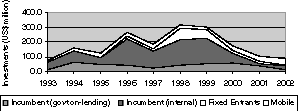
Figure 5. Telecommunications investment in Sri Lanka.
Source: Samarajiva and Dokeniya 2004.
A closer look at investment on the basis of sector, however, reveals mixed results, for investment by the dominant operator has declined over the past three years as investment by the other operators (particularly mobile operators) has increased. In 2002, for the first time, investment by other operators exceeded the level of investment by the dominant operator. While this increase in investment can be ascribed to the fact that a number of revolutionary technological changes are taking place within the sector, it is also indicative of the deep pockets for investing that mobile operators have. The decline in investment by the incumbent operators can be explained for the most part by the fact that the government owns the majority stake in SLTL, and despite privatization remnants of the practice of the government on lending have remained: investment decisions are thus determined to an extent by government decisions (Samarajiva and Dokeniya 2004).
IV. Conclusion
Despite the Interconnection Rules of 2003 and the telecommunications industry’s attempts to commit more stringently to Sri Lanka’s WTO commitments, its existing status has hampered any real effect the rules may have had in liberalising the telecommunications market further. The incumbent’s dominant position in the market and implicit collusion among the seven PSTN operators make it harder for any real liberalization efforts to take place. Regulatory weakness has meanwhile increased the incumbent operator’s power in the market.
There is little doubt that Sri Lanka’s ‘liberalized’ telecommunications market is still in need of massive reforms. There is ample room for the industry to grow and it is vital that the industry does indeed expand because of the various positive knock-on effects the telecommunications sector has on other segments of the economy. If the industry is to grow, however, it is imperative that all players in the policy and regulatory space commit more seriously towards liberalising the market. The regulator should, for example, resolve its internal issues and function more effectively and efficiently; currently, the TRCSL has a number of vacancies that remain unfilled because of the time that the ministry takes to appoint new people. In some cases, more deserving and capable people may be overlooked for those with political connections. Timbales in implementing policies should also be eliminated if one is to gauge accurately the effects of the new rules and ensure further liberalization in the market. Fixed and mobile operators meanwhile have to abide more strictly by the regulations set by the regulatory body. It is of vital importance that the telecommunications industry undergoes these changes if it is to progress and be sustained as an engine of growth for the rest of the economy.
Annex I Salient features of the Interconnection Rules of 2003:
- The Rules apply to every connectable
licensed operator who is authorized to connect at any interconnected
telecommunications system (Rule 2).
- Interconnection service is mandatory among
connectable operators and is required to be provided on an efficient,
non-discriminatory and cost-oriented basis (Rule 4).
- Every Access seeker must enter into an Interconnection Agreement with the Access Provider on such terms as are set out in the Rules (Rule 5(2)(a)). The terms and conditions on which interconnection are provided, both price and non-price terms, must represent world’s best practice (Rule 5(4)(e)).
Where the Access Provider fails to provide information, which is necessary to negotiate an agreement, to the Access Seeker within five working days, the Access Seeker may inform the TRCSL. The TRCSL would then make its determination (Rule 5(7)).
All parties to a negotiation must sign a non-disclosure agreement prior to commencement of the negotiations.
No interconnection Agreement comes into effect until the TRCSL issues a certificate that it conforms to the Rules (Rule 5 (11)). Rule 15 sets out the role of the TRCSL with respect to agreements entered into with the dominant operator.
Activities, including concealment or misinterpretation as to the origin or nature of traffic, are prohibited under Rule 9.
TRCSL would determine interconnection charges where parties fail to reach an agreement (Rule 10).
All disputes are referred to the TRCSL, which must make a determination within 30 days of the receipt of the complaint (Rules 5(16), 7(2) and 8(2)).
Source: Venugopal, 2003.
References
Asia Pacific Telecommunity (October 2003), ‘Guide
to Telecommunications Trade Principles, WTO Commitments and Doha
Development Round Negotiations’
Asia Pacific Telecommunity (February 2004), ‘Survey of
Telecommunications Development Strategies, Policies and WTO Commitments
of Asia-Pacific Economies’
Central Bank of Sri Lanka (2003), Annual Report 2003, Colombo:
Central Bank of Sri Lanka
Dharmawardena, Sumathi (February 2004), ‘Sri Lanka’s Experience in
Interconnection and Liberalization of International Telecommunications
Segment’, SAFIR Newsletter, 15, 2-7
Jayasuriya, Sisira and Malathy Knight-John (January 2002), ‘Sri Lanka’s
Telecommunications Industry: From Privatization to Anti-Competition?’,
Working Paper 14, Manchester: Centre on Regulation and Competition,
University of Manchester
Samarajiva, Rohan and Anupama Dokeniya (February 2004), ‘Regulation
and Investment: Sri Lanka Case Study’, discussion paper, WDR 0303,
World Dialogue on Regulation for Network Economies, available at
http://regulateonline.org/2003/dp/draftpapers/html
Sri Lanka Telecommunications Act, No. 25 of 1991, as amended by Sri
Lanka Telecommunications (Amendment) Act, No. 27 of 1996, available at
http///:www.trc.gov.lk
Venugopal, Krishnan (October 2003), ‘Telecommunications Sector
Negotiations at the WTO: Case Study of India, Sri Lanka and Malaysia’,
paper presented at the ITU/ESCAP/WTO Regional Seminar on
Telecommunications and Trade Issues, October 2003, Bangkok, Thailand,
available at
www.unescap.org/tid/mtg/ituwtoesc_s51b.pdf
World Trade Organization (1997), ‘Schedule of Specific Commitments of
Sri Lanka’, WTO Reference Paper, available at
https://itip-services-worldbank.wto.org
World Trade Organization (1997), ‘Telecommunications Reference Paper’,
available at http://www.wto.org/english/tratop_e/serv_e/telecom_e/tel23_e.htm
Zita, Ken and Akash Kapur (April 2004), ‘Sri Lanka Telecommunications
Brief’, USTDA South Asia Communications Infrastructure Conference, New
Delhi, April 2004, available at
http://topics.developmentgateway.org
NOTES:
1.- Available on the WTO website at
http://www.wto.org/english/tratop_e/serv_e/telecom_e/tel23_e.htm.
The Schedule of Sri Lanka’s Specific Commitments is available at
https://itip-services-worldbank.wto.org/. back to text
2.- The Telecommunications Annex elaborates a
framework of principles and rules affecting the regulatory environment
established by governments vis-à-vis telecommunications network
operators and other basic service providers. The Annex provides notes
and supplementary provisions to the General Agreement on Trade in
Services (GATS) (Asia Pacific Telecommunity 2003). back to text
3.- See WTO Telecommunications Reference
Paper. back to text
4.- See Annex I for salient features of the
Interconnection Rules of 2003. back to text
5.- Prior to this acquisition, SLTL owned 40%
of the firm. Mobitel was launched as a joint venture between Australia
Telstra and SLT. In 2002 SLTL bought out Telstra’s 60% and converted
Mobitel to a fully owned subsidiary of SLTL. back to text
6.- Investment has declined from US$303
million in 1999 to US$103 million in 2001 to US$87 million in 2002 (Zita
and Kapur 2004). back to text
* Institute of Policy Studies, Colombo, Sri Lanka. The views
expressed in this paper are those of the authors and do not necessarily
represent those of the Institute of Policy Studies.
Telecommunications Regulatory Commission of Sri Lanka, available at
http://www. trc.gov.lk.

