

MILLENNIUM DEVELOPMENT GOALS
Trade and development
The majority of WTO members are developing countries, so one of the main focuses in the organization is on ensuring that these countries are able to benefit from participating in international trade and from the multilateral trading system.
See also:
> Developing
countries in the WTO
The Agreement Establishing the WTO recognizes the need for positive efforts to ensure that developing countries, and especially those that are least-developed, share in the growth of international trade. This was also reiterated in the Doha Ministerial Declaration of 2001, which launched the current multilateral trade negotiations. These negotiations, known as the Doha Development Agenda (DDA), are central to the WTO’s contribution to achieving the MDGs.
In the Agreement Establishing the WTO, it is recognized that “there is need for positive efforts designed to ensure that developing countries, and especially the least developed among them, secure a share in the growth in international trade commensurate with the needs of their economic development”
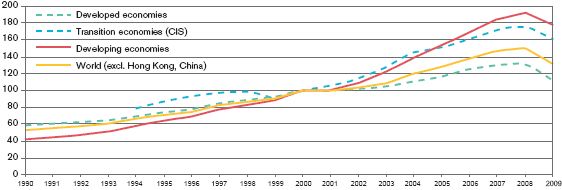
Over the years, trade openness has contributed considerably to enhancing developing countries’ participation in the global economy. Figure 1 shows that from 1990 to 2008, the volume of exports from developing countries grew consistently faster than exports from developed countries or the world as a whole, as did the share of developing countries’ exports in the value of total world exports. For example, between 2000 and 2008 the volume of developing countries’ exports almost doubled, while world exports increased by only 50 per cent.
Figure 1: Volume of exports of developed, developing and transition
economies: 1990-2009
(Index, 2000=100)
Source: WTO Secretariat estimates.
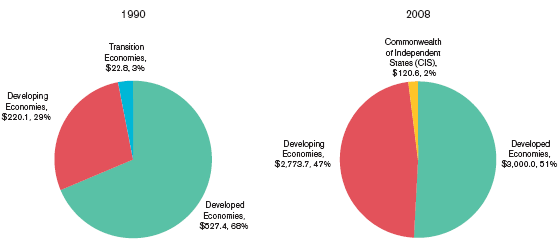
Trade between developing countries, South-South trade, has also seen a marked increase. The share of developing countries’ exports going to developing countries increased from 29 per cent in 1990 to 47 per cent in 2008 (see Figure 2).
Figure 2: Exports of developing economies by destination: 1990 and
2008
(Billion dollars and percentage)
Source: WTO Secretariat estimates
In fact, even in the recent economic crisis, the decline in the value of developing country exports was smaller than developed country exports. For instance, relative to the first quarter of 2007, developing and developed country exports fell by 28 and 35 per cent respectively in the second quarter of 2009(1). Moreover, the value of developing country exports began to decline only in the third quarter of 2008, as compared to developed countries for whom the decline started one quarter earlier. In addition, developing countries’ exports resisted the crisis better in the sense that their recovery has been more robust. For instance, in the fourth quarter of 2009, the value of developing country exports had reached their 2007 third quarter level, whereas the value of developed country exports had only reached their 2007 first quarter level.
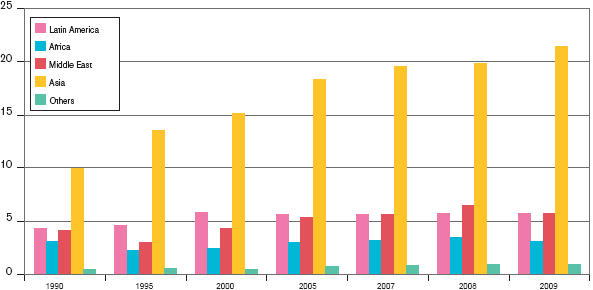
However, not all developing countries participate equally in international trade. Figure 3 provides a breakdown of developing countries’ exports by region. Asia is by far the most important exporting region in the developing country group, with a 10 per cent share of world exports in 1990 (US$ 335 million) which increased to 21 per cent (US$ 2,603 million) in 2009. In contrast, Africa had the smallest share in world exports, at 3 per cent, both in 1990 and 2009. Along with Africa, Latin America and the Middle East have not experienced a notable increase in the share of world exports from 1990 to 2009. At the same time, the value of these three regions’ exports did increase over the period: African exports, for example, increased from US$ 106 million in 1990 to US$ 379 million in 2009. In addition, LDCs accounted for only 2.8 per cent of the value of exports of the developing country group in 2009. This share has remained largely unchanged since 1990, although LDCs’ exports did increase in value, from US$ 18 million in 1990 to US$ 125 million in 2009.
Figure 3: Share of developing economies in the value of world exports, by region: 1990 to 2009 (per cent)
Source: WTO Secretariat estimates
More needs to be done to ensure a wider participation of developing countries in international trade, including reducing trade barriers further. This is especially important given the relationship between trade and economic growth.
A successful conclusion to the Doha Round would be a big step forward. Through the substantial trade opening and the reinforcement of disciplines in areas such as subsidies that would take place, developing countries would benefit from significant opportunities to enhance their share of world trade and would thereby be in a stronger position to use trade as an engine for growth, development and the achievement of the MDGs.

