trade monitoring — Joint reports on G-20 trade and investment measures
Trade-facilitating measures help offset rise in new G20 trade restrictions
More
- Trade monitoring - Joint reports on G-20 trade and investment measures
- Trade monitoring
- WTO and other organizations
- 33rd WTO Report on G20 Trade Measures
- 33rd Joint Summary on G20 Trade and Investment Measures (OECD/WTO/UNCTAD)
- Summary and Status of G20 trade and trade-related measures since October 2008
- 33rd OECD-UNCTAD report on G20 investment measures
Stockpile of other-import and other-export measures in force since 2009
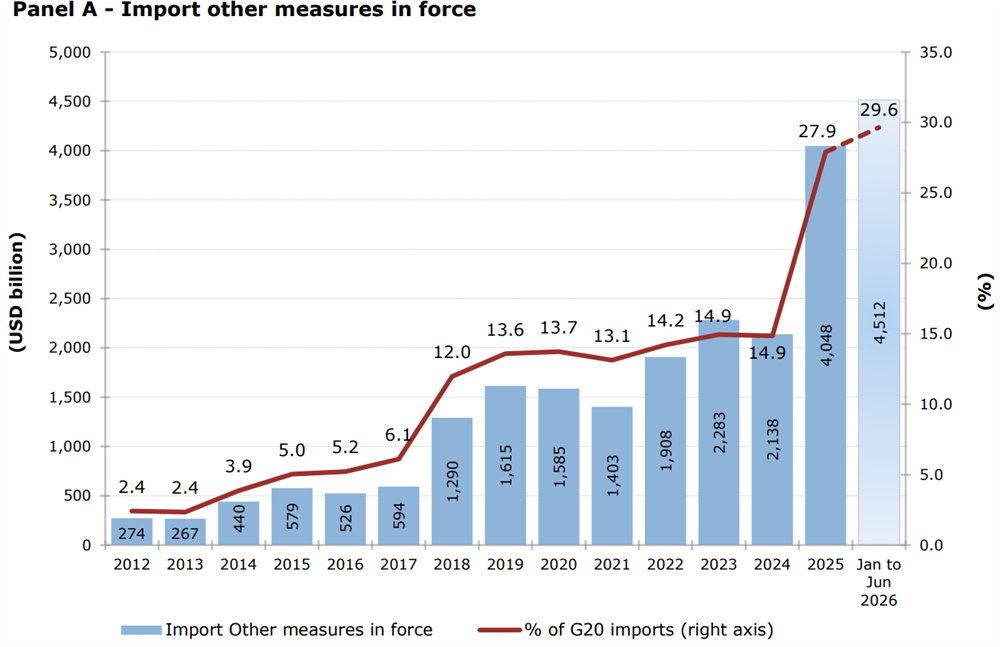
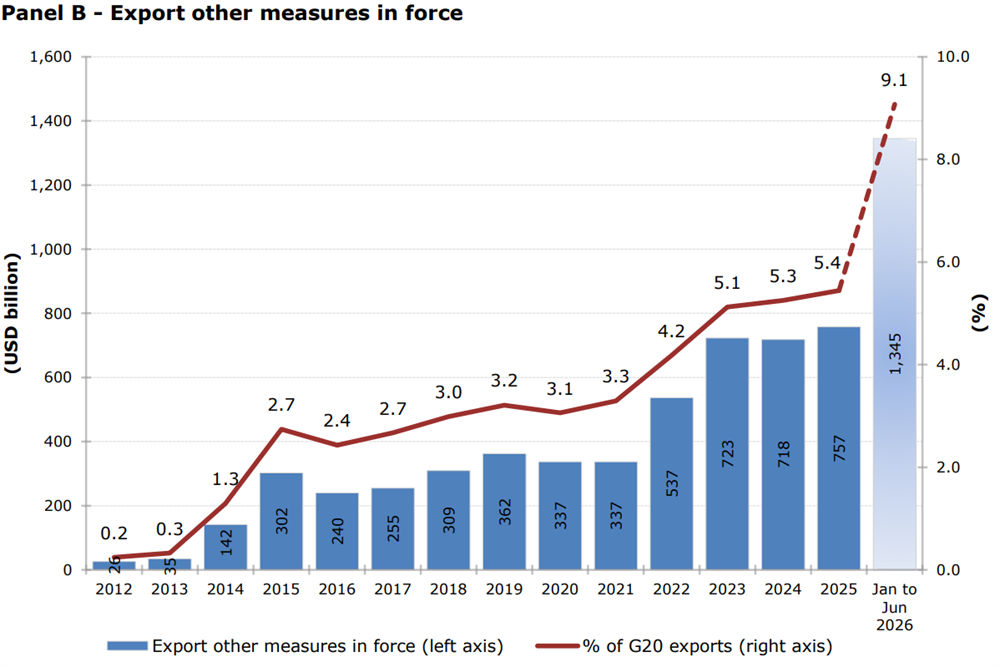
In 2025, G20 economies introduced 874 new trade and trade-related measures and a further 697 during the first half of 2026 alone. This includes a range of new measures as well as adjustments to existing trade measures, including changes to tariffs, export controls, and sector-specific measures as G20 economies navigate a complex global environment. The increase in trade policy activity was broad-based and not limited to the G20 economies, as noted by the WTO-wide monitoring report published on 29 October 2026, which can be accessed here.
G20 economies introduced 206 new restrictive and other non-facilitating trade measures in the first half of 2026, compared to 194 recorded during all of 2025. Import-related measures amounted to USD 2.0 trillion (12.9 per cent of G20 imports) in the first half of 2026, compared with USD 2.8 trillion (19.1 per cent) in all of 2025. These are the two highest levels on record and around ten times higher than those recorded over the past 15 years. Export-related measures, including changes in tariffs and export controls, soared to 4.8 per cent of G20 exports (USD 711 billion), compared to 0.9 per cent in 2025 (representing USD 126 billion), marking the highest level on record.
At the same time, new trade-facilitating measures accelerated sharply in the first half of 2026. G20 economies introduced 282 such measures, exceeding the 225 recorded during all of 2025. These import-facilitating measures covered an estimated USD 977 billion (6.4 per cent of G20 imports), compared with USD 1.1 trillion (7.8 per cent) in 2025. Export-facilitating measures reached USD 560 billion (3.8 per cent of G20 exports), more than five times the USD 101 billion (0.7 per cent) recorded in 2025, marking the highest level on record. Much of this increase reflected temporary responses to trade disruptions associated with the closure of the Strait of Hormuz, including tariff reductions and removals.
The report covers trade and trade-related measures up to 30 June 2026, presenting annual data for 2025 and semi-annual data for 2026. It also tracks the value of trade covered by measures introduced since 2009, known as "the stockpile," that remained in force as of the reporting date.
As of 30 June 2026, the stockpile of import-related restrictive and other non-facilitating measures introduced since 2009 reached USD 4.5 trillion, impacting 29.6 per cent of G20 imports, a rise from 27.9 per cent at the end of 2025. The stockpile of export-related measures also reached USD 1.3 trillion, covering 9.1 per cent of G20 exports, up from 5.4 per cent at the end of 2025.
WTO Director-General Ngozi Okonjo-Iweala said: "On the one hand, we are witnessing that import tariffs and other non-facilitating measures are significantly impacting global trade, with the stockpile of trade-restrictive and other non-facilitating measures reaching its highest level since WTO trade monitoring began in 2009. As of 30 June 2026, more than four-fifths of these measures affecting imports and exports were introduced by G20 economies, underscoring their substantial influence on global trade flows. On the other hand, G20 economies have demonstrated a commendable effort in keeping trade flowing-accounting for nearly three-quarters of all imports benefiting from WTO trade-facilitating actions and almost all exports benefiting from export-facilitating measures during 2025 and the first half of 2026.
She added: "I welcome these trade-facilitating efforts and urge WTO members to leverage this positive momentum, while exercising restraint in introducing new trade restrictions. Committing to fostering open, predictable, and transparent trade practices is essential for stimulating economic growth and preserving the valuable benefits of the multilateral trading system."
Global trade proved more resilient than projected in the first half of 2026, despite ongoing disruptions from the Middle East conflict, driven largely by surging demand for AI-enabling goods. On 8 October, the WTO revised its forecast for world merchandise trade volume growth in 2026 upward to 3.9 per cent, more than double the previous baseline forecast of 1.9 per cent issued in March. In value terms, merchandise trade increased by around 15 per cent year-on-year during the first half of 2026.
On the other hand, commercial services trade growth is now forecast at 3.3 per cent in 2026, reflecting a decrease from the March forecast of 4.8 per cent largely due to the impact of the Middle East conflict on transport and travel services. Nevertheless, in value terms, commercial services trade increased by around 14 per cent in the first half of 2026 compared to the same period in 2025.
Trade remedy actions continued to be widely utilized across G20 economies, although the trade affected by these measures remained limited. In 2025, G20 economies initiated 455 trade remedy actions, comprising 345 initiations and 110 terminations, with initiations averaging 28.8 per month. During the first half of 2026, 209 new trade remedy actions were recorded, including 188 initiations and 21 terminations, with the monthly average of new initiations rising to 31.3. Anti-dumping measures remained the most frequently utilized trade remedy instrument.
G20 economies continued to utilize the transparency mechanisms of the Sanitary and Phytosanitary (SPS) and Technical Barriers to Trade (TBT) Committees at the WTO to notify their related measures and to constructively address specific trade concerns without resorting to dispute settlement.
The report emphasizes the ongoing dialogue among G20 economies devoted to addressing underlying trade imbalances, coupled with intensified efforts to reach negotiated solutions.
G20 economies remained key players in global trade, while continuing to navigate the ongoing challenges posed by geopolitical tensions and economic disruption, the report finds. Their dual approach of increasing trade facilitation efforts while introducing targeted restrictive measures underscores the need for cooperative strategies to maintain robust trade flows that benefit the global economy.
The WTO Trade Monitoring Reports on G20 Trade Measures have been prepared since 2009 following a request from G20 Leaders to the WTO, the Organisation for Economic Co-operation and Development (OECD) and the United Nations Conference on Trade and Development (UNCTAD), to monitor and report on trade and investment measures implemented by G20 economies. The WTO Trade Monitoring Report on G20 Trade Measures is issued under the responsibility of the WTO Director-General, and its core objective is to provide transparency on the latest trends and developments in the implementation of a broad range of trade policy measures. It is circulated simultaneously with the G20 Report on Investment Measures, which is issued under the responsibility of the Secretary-General of the OECD and the Secretary-General of UNCTAD.
Share
Problems viewing this page? If so, please contact [email protected] giving details of the operating system and web browser you are using.